As promised, here's a review of the speech I attended last Thursday:
*********************************************************************************
Last week
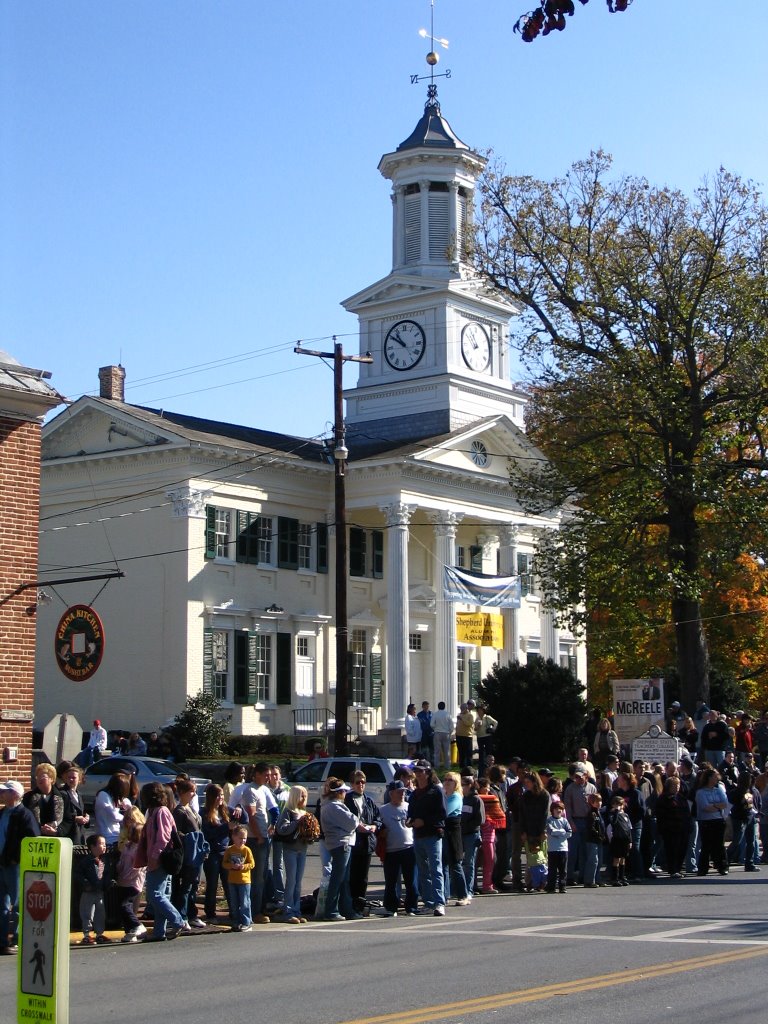
Shepherd University held the Second Annual
Tom E. Moses Speech on the Constitution as part of their Constitution Day events. The series began last year with a speech by Senator Byrd (D-WV) and continued this year with a presentation by
Joseph N. Onek titled “Follies and Failures: Constitutional Checks and Balances after 9/11.”
Onek began with a quick overview on the intent of the Founding Fathers in creating the Constitution, pointing out that the ultimate goal was to prevent executive tyranny. He also pointed out that the legislature should, “compliment the executive with wisdom and responsibility.” In doing so, he said, the Congress would “prevent foolish actions.”
Then he began his lecture on the current state of checks and balances. “Some suggest,” he said, “that the current president is somehow an example of what the Founders hoped to prevent. It is hyperbolic, however, to say that we are facing a tyranny.”
To illustrate his case, Onek turned to the situation in GuantanamoBay, Cuba. “Guantanamo Bay has become a world wide rallying cry for Jihadists,” he explained. He then launched into the much over stated belief that the Bush administration has some how burned up the mythical surplus of support and love that the world had for the US in the aftermath of 9/11 in establishing the POW camp (if we are to call it that).
He did, though, admit that it was more humane than the alternative: simply to kill all the “bad guys.” “Guantanamo Bay is a negative symbol in three ways,” he said.
The first item Onek pointed to was that Bush used a military order to establish military commissions. He explained that Bush modeled the commissions on Franklin Roosevelt’s declaration in the aftermath of Pearl Harbor. Onek condemned the facility at Guantanamo Bay as being “contradictory to the Uniform Code of Military Justice.” He pointed to the use of secret evidence, the use of “evidence obtained through coercion,” and the inability of the prisoners to appeal through our civilian court system as being the most negative aspects of using Guantanamo Bay.
He cited the selection of who should or should not be held as the second glaring mistake in the establishment of Guantanamo Bay. Onek pointed out that we used military tribunals on the actual battlefield during the Gulf War to decide who was/wasn’t an enemy. In this case, though, he stated that we just “took everybody” thus sweeping up “many innocents.” He also pointed out that Pakistan and the Northern Alliance in Afghanistan turned over POW’s. He was somewhat cynical in believing that a majority of those turned over by these two groups were innocents. The Pakistanis, he said, were friendly to the Taliban regime and more than likely protected the true bad guys. The Northern Alliance, though, was at the opposite extreme: they, he suggested, probably turned over anyone who did not pledge allegiance to them, even if these individuals had no ties to the Taliban.
The final point Onek made was to say that the use of coersion in obtaining information is “simply unacceptable.” By denying the rights outline in the Geneva Convention, Onek believed that Bush established the conditions for the “gross prisoner abuse” which “has occurred at Guantanamo.”
The next portion of Onek’s presentation was by far his strongest. He posed a question that most Americans who disagree with Bush’s policies should have been asking for that last six years: “Where has Congress been during all this?” Congress should have been ‘checking’ Bush’s power all along, yet they have remained totally inactive. When Congress has spoken up, they have “simply sided with the president thereby weakening their own power and rubber stamping the President’s agenda.” This is arguable. Folks like Onek never consider the possibility that Congress has approved of the “Bush Agenda” (if such a thing really exists) because the “Bush Agenda” is right? Isn’t that at least partly possible?
So why has Congress essentially been “asleep at the wheel?” According to Onek, our legislators are to blame for not checking Bush because the Republicans are in control—and they have a united front. The democrats, he said, also have a united front. Both of these points are, again, arguable. John McCain and Senator Warner have both been critical of the President over prisoner rights and treatment of detainees (though I disagree with McCain and Warner). “We can only believe,” he then explained, “that republicans stay quiet because they need Bush as a fundraiser.” This, again, is a weak argument as many republicans are (foolishly?) trying to distance themselves from Bush.
Onek then launched into a speech on the “death of ‘Men of the Senate.’” He said, “Men like Robert C. Byrd don’t exist anymore. Those who run for senate typically see their seat as a springboard through which they can set themselves up for a run for the Presidency. Robert Byrd nobly set aside any chance of running for president and voted against the Civil Rights Act in order to reserve power for the Senate.” For me, this was an unbelievable statement. It was more noble for Byrd to act to protect his own power than it was for him to extend equal rights to minorities?
Onek blamed republicans for a majority of the problems, but then changed his tune and said, “We now have a republican administration in charge, but things would not be totally different with the democrats in charge.”
One would find it difficult to argue against many of the points Onek made. His case was not presented in an overly bias was which sought to place the majority of the blame on Bush. It was clear, though, the he was not a fan of our President. He did paint Bush as being politically incompetent as well as a power hungry leader. He did not, however, perpetuate the notion that Bush is somehow a tyrannical king.
One can, however, continue to argue whether there is even any validity in the illegality of the Guantanamo Bay situation. Most disturbing was the fact that he offered no alternative to the way Bush has carried out the War on Terror, even in the face of his own admission that seemingly the only alternative would be to kill all that are suspected of terrorist activity.
Following his speech, he led a question answer session. The first question right off the bat was, “Aren’t these offenses impeachable and when should we impeach him?” To his credit, Onek answered correctly. Firstly, he pointed out that there is no such thing as an “impeachable offense,” but rather that the House must make a case that he is worthy of impeachment for any particular reason. Secondly, he explained that he sees it as “most unlikely” that the democrats will win control of the Congress thereby enabling impeachment and that “impeachment would be a foolish case of bad judgment” on the part of the democrats.
The second question was, “well since we can’t impeach him, can’t he be tried for war crimes?” In response, Onek addressed Bush’s recent speech calling for protection of higher-ups from such charges. He also, again, said that it would be foolish for anyone to call for such charges, as it would open up opportunity for foreign nations to put out warrants for any number of things they see as “war crimes” or “war crime violations” and arrest, try and sentence a wide variety of leaders from a multitude of nations.
Someone then asked, “You keep saying POW, but these men can’t be POW’s can they? Congress hasn’t declared war?” At this point, Onek defended Bush. “In a very broad sense, they have declared war. Opponents of Bush can’t say that he hasn’t sought Congressional approval. If we seek to blame a specific group, we must blame Congress.”
The speech was informative and overall mostly unbiased. While he left many things unanswered, I can’t truly fault him for the case he attempted to make. Still, as we have seen so many times, it is so easy to outline the mistakes made in the aftermath of a decision, yet offer no alternatives. He truly could have been a spokesman for the entire political left’s biggest fault.
Labels: Guantanamo Bay, Shepherd University


 .
.